
Title 24 Energy Compliance in Diamond Bar, CA
Title 24 energy compliance is a California state requirement that every new ADU – detached, attached, or converted – must satisfy before the building department issues a permit. The compliance report documents insulation values, window performance, HVAC efficiency, and lighting specifications, and it travels with your permit set from plan check to final inspection. Without it, Diamond Bar’s Building and Safety Division will not release your permit, full stop.
At Ellery ADU Studio Diamond Bar, energy compliance isn’t a form we outsource the night before plan check. It’s produced in-house as part of the same ADU Design & Permitting in Diamond Bar package that covers your site plan, floor plan, structural sheets, and mechanical drawings. One contract, one written price, and one team accountable for every page of the permit set. If you have questions or want to understand what compliance will cost for your specific property, call us at (657) 239-4865 – a live person answers every call.
Nadia Ellery has led the studio since 2015 and has seen Title 24 compliance evolve through three major code cycles. The version in effect today – the 2022 Energy Code, which became mandatory for permits applied after January 2023 – is significantly stricter than what most homeowners remember from an older remodel permit. Diamond Bar’s inland location matters here: the city sits in California Climate Zone 10, a designation that shapes the minimum insulation R-values, the duct leakage requirements, and the solar-readiness rules that apply to your project.
When You Need Title 24 Energy Compliance
The short answer is: any time you pull an ADU permit in Diamond Bar. But these are the situations where compliance tends to be the step people discover late – and where catching it early saves real money.
- You’re adding a new detached ADU. Every new-construction ADU in Diamond Bar requires a full CF1R compliance report stamped by a certified HERS rater before plan check. There’s no minimum square footage below which the requirement disappears.
- You’re converting a garage to living space. A garage-to-ADU conversion triggers the energy code because the space is changing its occupancy classification. The existing walls, ceiling, and any existing HVAC equipment all get evaluated against 2022 standards – and the gaps between framing members in a typical Diamond Bar attached garage are rarely deep enough for modern R-values without adding continuous insulation on the interior face.
- Your permit application was rejected at plan check. The most common correction notice we see from Diamond Bar’s Building and Safety Division is a missing or incomplete CF1R. If you’re already in that position, we can step in and produce the report as a standalone deliverable alongside corrected architectural sheets.
- You received a Title 24 report from another designer but construction hasn’t started. Reports specify a particular mechanical system, a particular window U-factor, and a particular duct configuration. If your builder substituted products during framing without updating the compliance file, the HERS field verification will fail and your final inspection will stall. We audit existing reports and rerun calculations when product substitutions occur.
- You’re building with a prefab or modular unit. Systems like Mighty Buildings and Plant Prefab ship with factory-tested thermal envelopes and STC ratings – but those ratings still have to be mapped into a site-specific CF1R that reflects your Diamond Bar lot’s orientation, your utility provider (Southern California Edison in most of the city), and your specific HVAC selection. The factory documentation doesn’t substitute for the state-required report.
- Your ADU includes a battery storage system or solar array. The 2022 Energy Code’s solar-readiness provisions and the statewide solar mandate for new construction intersect in ways that affect your electrical plan and your compliance calculations. We run those numbers before the electrical sheets go to plan check, not after.
Our Title 24 Energy Compliance Process
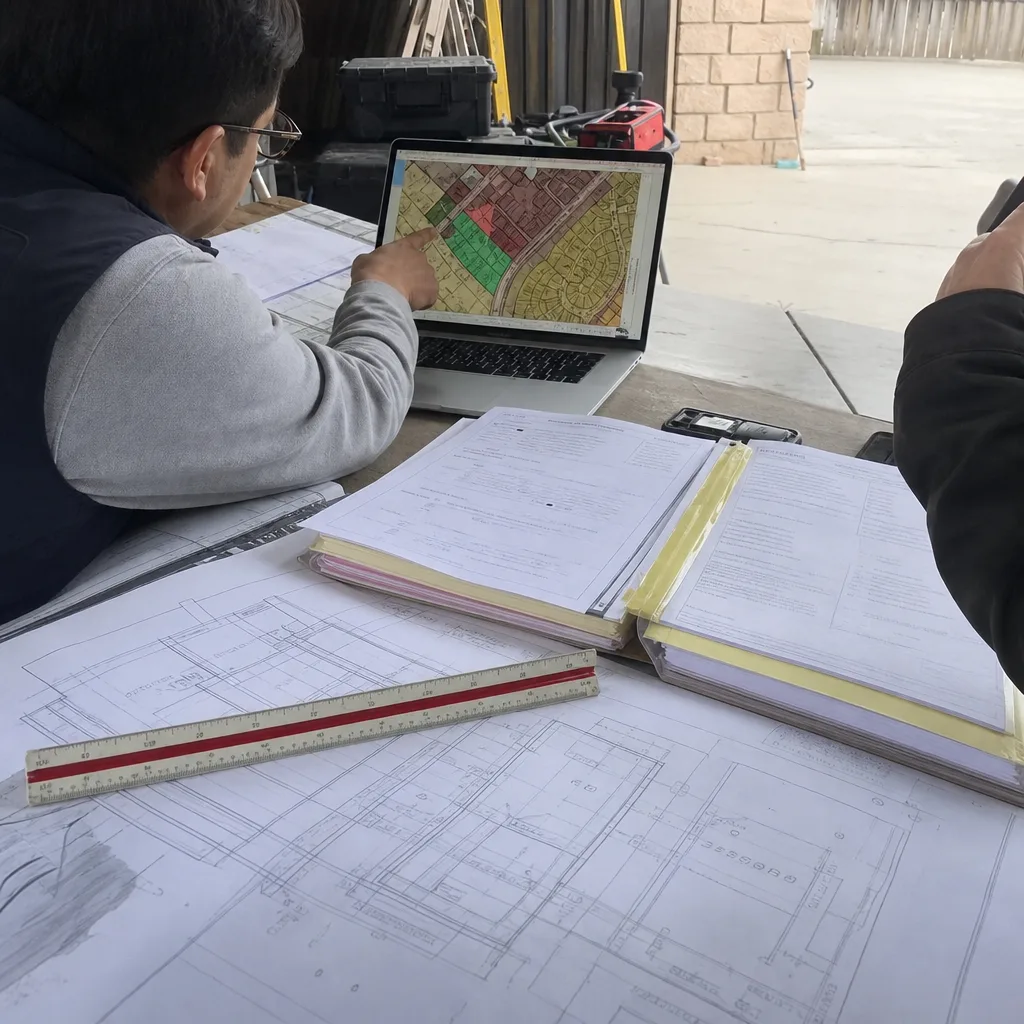
Here’s exactly what happens from the day you sign with us to the day the compliance file is stamped and submitted. Nothing about this process is a black box – every deliverable is described in your written scope before work begins, per Haven Standard Clause 1, including our ADU Design & Blueprints.
- Site and orientation assessment. We record your lot’s true north orientation, the wall-to-wall dimensions of the proposed ADU, and the shading from adjacent structures or mature trees. In Diamond Bar’s canyon neighborhoods – Summitridge, Pantera, the streets running off Diamond Bar Boulevard toward Brea Canyon – mature eucalyptus and sycamore canopy affects solar heat gain calculations in ways that can reduce the required glazing area and lower your window budget. We document what we find, not what we assume.
- Energy modeling with CEC-approved software. We run your project through California Energy Commission-approved compliance software, entering Climate Zone 10 parameters, your proposed wall assembly, roof assembly, window specifications, HVAC equipment model numbers, and duct routing. The output is a CF1R report – the Certificate of Compliance – that specifies every performance threshold your builder must hit.
- Coordination with your architectural and mechanical drawings. The CF1R doesn’t live in isolation. We cross-reference window schedules, insulation callouts on wall sections, and mechanical equipment schedules so that the drawings and the compliance report say the same thing. A discrepancy between the CF1R and the mechanical plan is the most common reason plan checkers issue a Title 24 correction notice.
- HERS rater coordination. California requires a third-party Home Energy Rating System (HERS) rater to verify certain measures in the field – duct leakage, refrigerant charge, airflow, and fenestration installation, among others. We identify which mandatory HERS verification measures apply to your project, document them on the CF2R (the installation certificate), and coordinate scheduling with a certified HERS rater. You don’t have to find one yourself.
- Plan check support through approval. If Diamond Bar’s plan checker has a question about the compliance report – and they do ask, particularly on projects with non-standard window-to-wall ratios or ductless mini-split configurations – we respond directly. Under the 365-Day Done Right Promise, if the compliance report doesn’t pass because of an error on our part, we correct it at no additional charge.
- Final CF3R documentation at inspection. When the HERS rater completes field verification, the CF3R (the Certificate of Installation) is generated and uploaded to the state’s HERS registry. That document is what the Diamond Bar building inspector looks for at final inspection. We confirm it’s filed before your inspection is scheduled – not the morning of.
Title 24 Energy Compliance Pricing in Diamond Bar
Title 24 energy compliance in Diamond Bar, when produced as part of our ADU Design & Permitting services, is included in your project’s written all-in price. There is no separate line-item surprise at the end. The table below shows typical standalone ranges for reference – what you’d pay if you came to us with an existing set of drawings that need a compliance report only, or if you’re auditing a report produced by someone else.
| Scope | Typical Range (Diamond Bar market, 2025-2026) |
|---|---|
| CF1R report for new detached ADU, up to 600 sq ft | $900 – $1,400 |
| CF1R report for new detached ADU, 601-1,200 sq ft | $1,200 – $1,900 |
| Garage conversion compliance report (existing structure) | $750 – $1,200 |
| Compliance audit + revision of an existing third-party report | $500 – $950 |
| HERS rater coordination and scheduling (pass-through cost) | $300 – $600 per inspection visit |
What moves the number up or down in Diamond Bar specifically:
- Mechanical system complexity. A straightforward ductless mini-split with no duct leakage testing simplifies the compliance report and typically keeps the HERS rater visit to a single field check. A ducted central system in a garage conversion – common in larger units on properties along Pathfinder Road and in the Country Estates area – requires duct leakage testing and sometimes a second HERS visit.
- Solar and battery storage. If your project triggers the statewide solar mandate (which applies to all new ADUs with electrical service), the compliance model has to account for the array size and the battery system. This adds modeling time.
- Plan check revision cycles. If we’re stepping in to fix a report prepared by someone else, the number of correction cycles already issued by Diamond Bar Building and Safety affects how much rework is required.
- Prefab unit compliance mapping. A Mighty Buildings or Plant Prefab unit with factory-certified wall assemblies reduces some modeling complexity, but the site-specific orientation, shading, and utility-provider data still have to be entered from scratch.
Every project quoted at Ellery ADU Studio Diamond Bar receives a written price before any work begins – Haven Standard Clause 1, no exceptions – so you always know how much ADU Design & Permitting costs upfront. That written price is what you pay. If you have a written estimate from another firm and want a second set of eyes on what’s included, we offer a free second opinion on any written estimate already in hand. Call (657) 239-4865 and we’ll schedule time with Nadia Ellery’s team to review what you have.
FAQs – Title 24 Energy Compliance in Diamond Bar
What is Title 24 energy compliance and why does Diamond Bar require it?
Title 24 Part 6 is California’s Building Energy Efficiency Standards, updated every three years by the California Energy Commission. Diamond Bar requires a stamped CF1R compliance report for every new ADU and every change-of-occupancy project – like a garage conversion – because the city enforces the state building code in full, with no local exemptions for small units. The report proves that your insulation, windows, HVAC, and lighting meet the minimum performance thresholds for Climate Zone 10. Without it, the Building and Safety Division will not issue a permit, and the project cannot legally proceed. Call (657) 239-4865 if you want to talk through what the requirement means for your specific property.
Can I use the Title 24 report from my architect instead of getting a new one?
Yes, if the report was produced correctly and your builder has not substituted any specified products. In practice, the problem is substitution: a builder sources a different window brand with a slightly different U-factor, or swaps an HVAC unit for an equivalent model that isn’t listed on the CF1R. When the HERS rater does field verification, the installed product doesn’t match the compliance file, and the inspection fails. If you have an existing report and want us to audit it against your current construction drawings and product submittals, we do that for a flat fee within the range listed above. Call (657) 239-4865 to get a written quote for the audit.
How long does the Title 24 compliance process take in Diamond Bar?
Producing the CF1R report takes five to ten business days from the point we have complete architectural drawings, a confirmed mechanical system selection, and your lot’s true north orientation. HERS field verification scheduling depends on construction progress – the rater needs to inspect before drywall covers the insulation and before the mechanical system is commissioned. We factor these inspection windows into your project schedule from the start so they don’t become last-minute bottlenecks. Diamond Bar’s plan check currently runs three to five weeks for over-the-counter ADU submittals; having the compliance report complete and cross-referenced with the mechanical plan before submission is the most reliable way to avoid a correction notice that restarts that clock.
Does a Junior ADU or interior conversion need Title 24 compliance?
A Junior ADU created by converting existing interior space – like a bedroom suite with its own entrance – may qualify for a streamlined compliance pathway rather than a full CF1R, depending on whether the mechanical system is being modified and whether the existing insulation meets current minimums. In Diamond Bar, most pre-2000 homes have wall insulation below current R-13 minimums and attic insulation below R-38, which means the streamlined pathway often isn’t available without some remediation. We assess this at the start of your project and tell you exactly which path applies and what it costs – in writing, before any work begins. Call (657) 239-4865 for a written scope on your specific unit.
Why Diamond Bar’s Climate Zone 10 Matters for Your ADU
Climate Zone 10 covers the inland valleys east of the Los Angeles basin – Diamond Bar, Walnut, Pomona, and the western edge of the San Gabriel Valley. It’s characterized by hotter summers and cooler winters than coastal zones, which is why the energy code specifies higher ceiling insulation minimums and tighter duct leakage thresholds here than in, say, Santa Monica. The cooling load drives most of the compliance decisions for a Diamond Bar ADU: window orientation, shading devices, and the SEER rating of your cooling equipment all have outsized effects on your compliance score.
In practice, this means south- and west-facing ADUs on lots in Diamond Bar’s ridge and foothill areas – particularly the streets above Diamond Bar Boulevard and in the Tres Hermanos corridor – often need either higher-performance glazing (U-factor at or below 0.30, SHGC at or below 0.23) or exterior shading to pass the performance test. We’ve seen projects where specifying the right window package costs less than the alternative compliance measure the energy model would otherwise require. That kind of tradeoff analysis is part of what the compliance report is for.
We also find that many Diamond Bar homeowners underestimate the HVAC duct leakage requirement. The 2022 code requires duct leakage to be no greater than 15% of system airflow in existing buildings and 5% in new construction. A garage conversion that reuses the original house’s duct trunk with a new extension routinely fails the 5% threshold unless the existing ductwork is sealed and tested before rough inspection. This isn’t a surprise we drop on clients at framing – it’s documented in your scope and priced before you sign.
Ellery ADU Studio Diamond Bar has been producing permit sets in this climate zone since 2015, across more than 900 ADU projects. The compliance process is not rote for us – every lot orientation, every existing structure, and every mechanical selection produces a different energy model. What stays constant is the written price, the documented photo record, and the commitment that if the compliance work we deliver doesn’t pass plan check because of something we did, we fix it. That’s the 365-Day Done Right Promise, and it’s in your contract from day one.
If you’re ready to understand exactly what Title 24 compliance will require on your Diamond Bar property – and what it will cost – call Nadia Ellery’s team at (657) 239-4865. A live person picks up every call. We’ll review your lot, your proposed unit, and your timeline, and we’ll give you a written price before any work begins if you’re looking for ADU Design & Permitting near me in Diamond Bar, CA. That’s Haven Standard Clause 1, and it’s how every project at Ellery ADU Studio Diamond Bar starts.
You can also learn more about the full scope of work that wraps around this compliance step on our ADU Design & Permitting in Diamond Bar page, or visit our home page for an overview of everything Ellery ADU Studio Diamond Bar covers under one contract.
Written by Nadia Ellery, Owner at Ellery ADU Studio Diamond Bar, serving Diamond Bar.